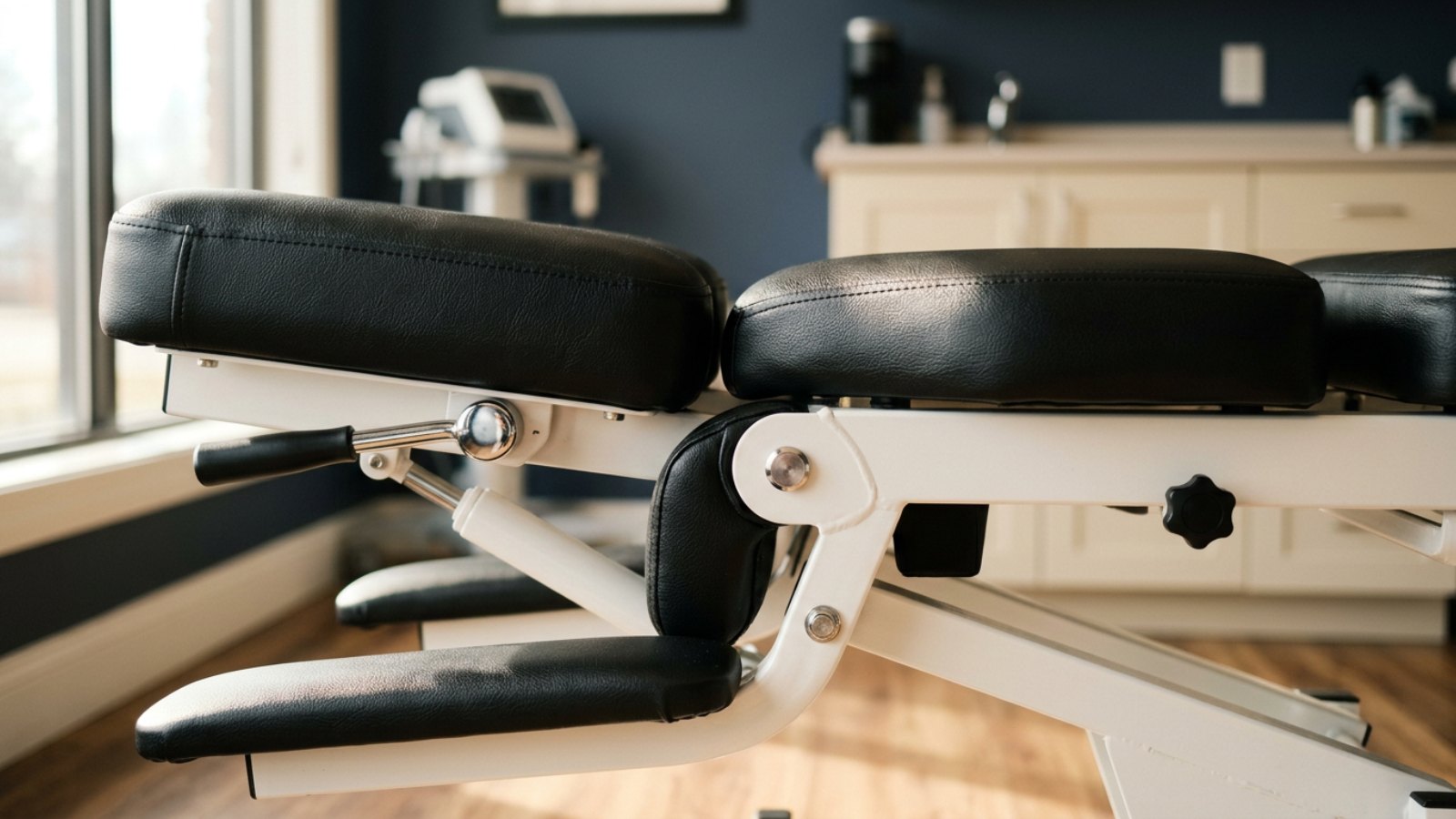
Cox decompression for a herniated disc is a hands-on technique performed on a table that flexes and gently distracts the lumbar spine. Most disc herniations improve without surgery: symptoms resolve in 60% to 80% of patients within 6 to 12 weeks [1] — so improvement after a course of care cannot be credited to the care.
Key takeaways
- Symptoms resolve without surgery in 60% to 80% of patients within 6 to 12 weeks, and 80% to 90% within a year [1].
- Herniated material often shrinks on its own: spontaneous resorption in 66.66% of cases across 11 cohort studies [2].
- Larger herniations regress more often than small ones: 96% for sequestrations, 13% for bulging discs [3].
- One unblinded trial found flexion-distraction beat exercise on pain but not disability [6]; a Cochrane review of traction found little or no impact [7].
- Cauda equina syndrome is a surgical emergency, and manipulation of any sort is contraindicated in its presence [8].
What usually happens to a herniated disc
A disc herniates when inner material pushes through its tough outer ring; against a nerve root it can cause pain, numbness or weakness down a leg (sciatica). Imaging grades herniations as bulge, protrusion, extrusion, or sequestration, where a fragment separates entirely [3].
The natural history is good. Symptoms resolve in 60% to 80% of patients in 6 to 12 weeks, and in 80% to 90% over a year or more [1]; Cleveland Clinic puts non-surgical recovery at 9 out of 10 people [9]. The material shrinks on repeat imaging too — spontaneous resorption in 66.66% of cases across 11 cohort studies [2] — and regression reached 96% for sequestrations against 13% for bulges [3]. The more dramatic the herniation, the likelier it resolves.
Because most herniations resolve on their own, improvement during a course of care cannot be attributed to that care.
What Cox flexion-distraction actually is
The patient lies prone on a specialized table whose caudal section the clinician moves through repeated short cycles, producing flexion and axial traction at a targeted level [5]. It is used with low back pain, radiating leg pain and disc findings on imaging — who receives it, not how well it works. Hunterdon Back Pain Center has dedicated Cox tables on site.
The mechanism is less settled than marketing suggests. In a pilot study of eight unembalmed human cadavers, intradiscal pressure fell during flexion-distraction, some unpressurized discs dropping below 0 kPa, returning to baseline the moment the table returned to neutral; the authors wrote that "no data validating the reduction of disc bulge and change in the nutrients exist at this time" [5]. We know of no in-vivo human imaging evidence that it retracts herniated material, so we do not claim it.
What the research shows, and what it does not
Spinal manipulation is among the nonpharmacologic options the American College of Physicians recommends as initial treatment for low back pain, a strong recommendation on low-quality evidence; the same guideline notes that "acute and subacute low back pain usually improves over time regardless of treatment" [4]. It does not address disc herniation. Six to twelve weeks of conservative treatment are recommended absent significant neurologic deficits [1].
A randomized trial of 235 patients compared flexion-distraction with active trunk exercise. Both improved (P<0.01); flexion-distraction gave significantly greater pain relief (P=0.01), with no significant difference on Roland-Morris disability or the SF-36. Patients with radiculopathy did better with it, on subgroup analysis. The trial was unblinded, had no sham arm, and enrolled chronic low back pain rather than imaging-confirmed herniation [6].
It is also traction-based, and a Cochrane review of 32 trials and 2,762 participants found traction "has little or no impact on pain intensity, functional status, global improvement and return to work" in low back pain [7].
Symptoms that call for urgent evaluation
"Manipulation of any sort is contraindicated in the presence of CES, as this represents a surgical emergency" [8]. Bladder or bowel dysfunction requires immediate decompression within 24 to 48 hours, and a severe motor deficit graded 3/5 or weaker should be offered surgery within three days [1]. Associated symptoms include loss of bladder or bowel control, numbness or weakness, and trouble standing or walking [9].
This is education, not a self-triage checklist; anyone weighing their own symptoms should see a qualified provider, and an emergency means calling 911. Our first visit post describes an evaluation.
Frequently asked questions
Does Cox decompression pull a herniated disc back into place?
We cannot say it does. In the eight-cadaver pilot study behind that idea, the authors wrote that "no data validating the reduction of disc bulge and change in the nutrients exist at this time" [5].
Are larger herniations less likely to resolve?
Imaging points the other way: regression reached 96% for sequestrations and 70% for extrusions, against 41% for protrusions and 13% for bulging discs [3].
Sources
- Kögl N, Petr O, Löscher W, Liljenqvist U, Thomé C. Lumbar Disc Herniation — The Significance of Symptom Duration for the Indication for Surgery. Dtsch Arztebl Int. 2024. doi:10.3238/arztebl.m2024.0074. Link
- Zhong M, Liu JT, Jiang H, et al. Incidence of Spontaneous Resorption of Lumbar Disc Herniation: A Meta-Analysis. Pain Physician 2017;20(1):E45–E52. Link
- Chiu CC, Chuang TY, Chang KH, et al. The probability of spontaneous regression of lumbar herniated disc: a systematic review. Clin Rehabil 2015;29(2):184–195. Link
- Qaseem A, Wilt TJ, McLean RM, Forciea MA. Noninvasive Treatments for Acute, Subacute, and Chronic Low Back Pain: A Clinical Practice Guideline From the American College of Physicians. Ann Intern Med 2017;166(7):514–530. doi:10.7326/M16-2367. Link
- Gudavalli MR, Cramer GD, Patwardhan AG. Intradiscal Pressure Changes During Flexion-Distraction Manipulation: A Cadaveric Pilot Study. Integrative Medicine Reports. 2022. doi:10.1089/imr.2022.0002. Link
- Gudavalli MR, Cambron JA, McGregor M, et al. A randomized clinical trial and subgroup analysis to compare flexion-distraction with active exercise for chronic low back pain. Eur Spine J 2006;15(7):1070–1082. Link
- Wegner I, Widyahening IS, van Tulder MW, et al. Traction for low back pain with or without sciatica. Cochrane Database of Systematic Reviews 2013, CD003010. Link
- Oliphant D. Safety of spinal manipulation in the treatment of lumbar disk herniations: a systematic review and risk assessment. J Manipulative Physiol Ther 2004;27(3):197–210. Link
- Cleveland Clinic. Herniated Disk. Reviewed 22 October 2024. Link