
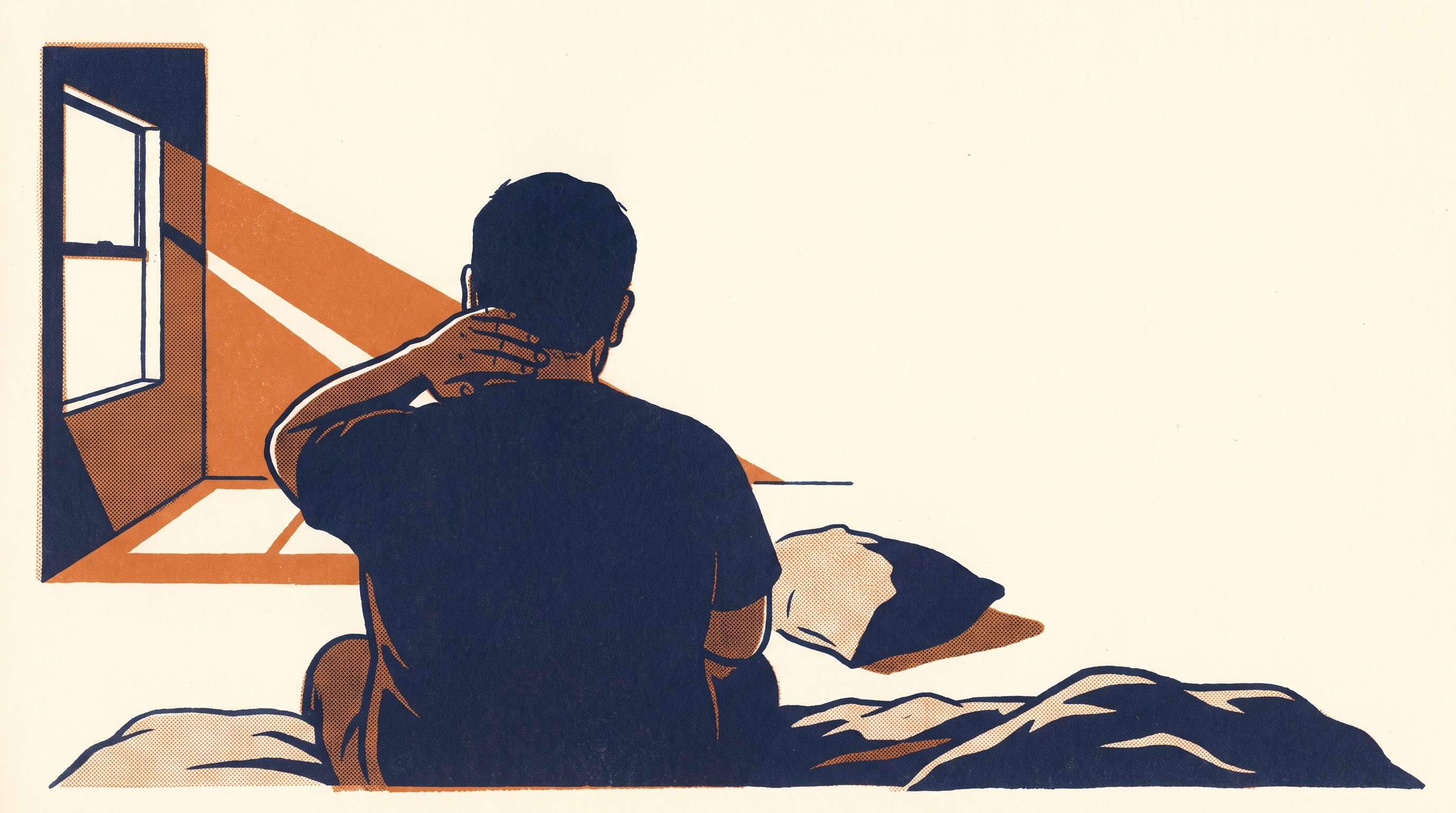
Neck pain from sleeping wrong is usually non-specific mechanical neck pain — sore muscles and joints rather than a diagnosis. Research has not established sleep position as the cause. Guidelines recommend multimodal care combining manual therapy with exercise and advice, and most neck pain improves without surgery. Pain after an injury, or spreading into an arm, needs evaluation.
Key takeaways
- Waking with a stiff neck is common, and most new neck pain is non-specific mechanical pain rather than a single identifiable injury.
- We could not find evidence establishing that a particular sleeping position causes neck pain, so this article does not claim your pillow is the culprit.
- A clinical practice guideline from the OPTIMa Collaboration recommends multimodal care — manual therapy combined with exercise and advice — for recent-onset grade I and II neck pain.
- A Cochrane review found moderate-quality evidence that thoracic manipulation improved pain and function in acute and chronic neck pain.
- NCCIH describes spinal manipulation as generally safe with a trained, licensed practitioner, with mild soreness the most commonly reported side effect and serious complications reported rarely.
- Neck pain that follows a collision or fall, is severe, or spreads into the arms with numbness or weakness calls for a medical evaluation rather than waiting.
What is actually going on when you wake up with a stiff neck
Most new neck pain is what clinicians call non-specific: the discomfort is coming from the muscles, joints, ligaments and discs of the neck, and no single structure can be pinpointed as the source. The National Institute of Arthritis and Musculoskeletal and Skin Diseases describes neck pain as commonly arising from the soft tissues and joints of the cervical spine, with most cases improving without surgery [3].
Here is the part a chiropractic office does not usually say out loud. We could not find evidence establishing that a particular sleeping position causes neck pain. Waking up sore after a night in an awkward position is a real and common experience, and holding one position for hours is a plausible contributor — but plausible is not proven, and the research does not support telling you that your pillow or your side-sleeping caused this. What is better supported is the ordinary picture: neck pain is common, it is usually mechanical, and it usually settles [3].
What the evidence says about manual therapy for neck pain
This is worth stating plainly, because it is the strongest evidence in this article. A clinical practice guideline from the Ontario Protocol for Traffic Injury Management (OPTIMa) Collaboration, developed from a systematic review of the neck pain literature, recommends multimodal care — manual therapy combined with exercise and advice — for recent-onset grade I and II neck pain, rather than rest or a single passive treatment on its own [2].
A Cochrane systematic review of manipulation and mobilisation for neck pain found moderate-quality evidence that thoracic manipulation — applied to the upper back rather than the neck itself — improved pain and function in people with acute and chronic neck pain, and found cervical manipulation and cervical mobilisation to produce similar changes when compared with one another [1]. The same review found that manipulation and mobilisation delivered on their own were generally not better than other active treatments, which is why guidelines point toward manual therapy plus exercise rather than manual therapy alone [2].
The National Center for Complementary and Integrative Health, part of the National Institutes of Health, describes spinal manipulation as generally safe when performed by a trained and licensed practitioner, with mild soreness or stiffness the most commonly reported side effect [5]. Serious complications after cervical manipulation are reported rarely, and NCCIH notes that a practitioner should take a history and examine you before treating [5].
What people do in the first few days
Guideline-recommended care is multimodal, so the self-care half matters as much as the hands-on half [2]. Mayo Clinic lists gentle stretching, staying active within comfort, over-the-counter pain relievers, and alternating heat and ice among the self-care measures commonly used for neck pain that is not caused by injury [4].
- Keep moving inside your comfort range. Prolonged rest and bracing the neck are not what current guidelines recommend for recent-onset neck pain [2].
- Heat or ice is a comfort decision. Mayo Clinic lists both; there is no strong evidence naming a winner, so use whichever lets you move more [4].
- We are not going to recommend a pillow. Since the evidence does not establish sleep position as the cause, we cannot honestly claim a product fixes it.
Anyone taking medication should check with their physician or pharmacist about what is appropriate for them.
Signs that call for a medical evaluation rather than waiting
Mayo Clinic advises seeking immediate care if neck pain follows an injury such as a motor vehicle collision, a diving accident or a fall, and contacting a health care professional if the pain is severe, persists for several days without relief, spreads down the arms or legs, or comes with headache, numbness, weakness or tingling [4].
This is education, not a self-triage tool. If any of it describes you, the next step is a qualified provider looking at your neck.
One point about imaging is worth correcting, because the advice for the low back gets copied onto the neck and it does not transfer. For acute low back pain without red flags, guidelines discourage routine X-rays. The neck is treated differently: the American College of Radiology's Appropriateness Criteria state that radiographs are appropriate as initial imaging for cervical or neck pain in the absence of red flag symptoms, or where chronic symptoms are unchanging [6]. Appropriate is not the same as automatic. New Jersey requires a chiropractor to document the clinical indication for any test ordered (N.J.A.C. 13:44E-2.2) [7], so whether an image is taken should follow from what the examination finds.
Getting a neck looked at in Clinton, NJ and Hunterdon County
Hunterdon Back Pain Center is a chiropractic practice in Clinton, New Jersey, serving Hunterdon and Warren County communities including Flemington, Lebanon, Annandale, Whitehouse Station, High Bridge and Washington. A visit starts with history and examination before any treatment decision [5]. You can read what to expect at a first visit, see our Clinton, NJ chiropractic page, or read about care across Hunterdon County.
We are not going to tell you how many visits this will take. A number published before anyone has examined you was set without evidence. If the pain travels into an arm, our posts on flexion-distraction for a herniated disc and on whether a chiropractor can help with sciatica cover the same reasoning applied to the lower spine.